Meatloaf Recipe has been a constant in my kitchen rotation for years, and I still get a little thrill when that glossy glaze hits the oven. I first learned to make this Meatloaf Recipe on a weeknight when I needed something comforting, fast, and reliably delicious. Over time I’ve tweaked the glaze and learned how to keep the loaf moist without overworking the meat. If you love homey, hands-on cooking that rewards you with generous leftovers, this is one you will come back to.
How This Meatloaf Recipe Became My Rainy-Day Favorite
There was a stormy Sunday when I first made this Meatloaf Recipe for a house full of friends who staggered in cold and hungry. I remember the sizzle of butter and olive oil as the onions softened, the tomato paste deepening to a jammy sweetness, and the kitchen filling with warm, savory smell. We stood around the counter—mismatched mugs in hand—while the loaf baked, and by the time it came out the glaze was gleaming like a tiny crown. That night felt like a small ritual: comfort food that stitched a chaotic day back together. Every time I make it now, I think of that rain, the chatter, and how a simple meatloaf turned strangers into a tableful of smiling faces.
The Ingredients That Make This Meatloaf Recipe Sing
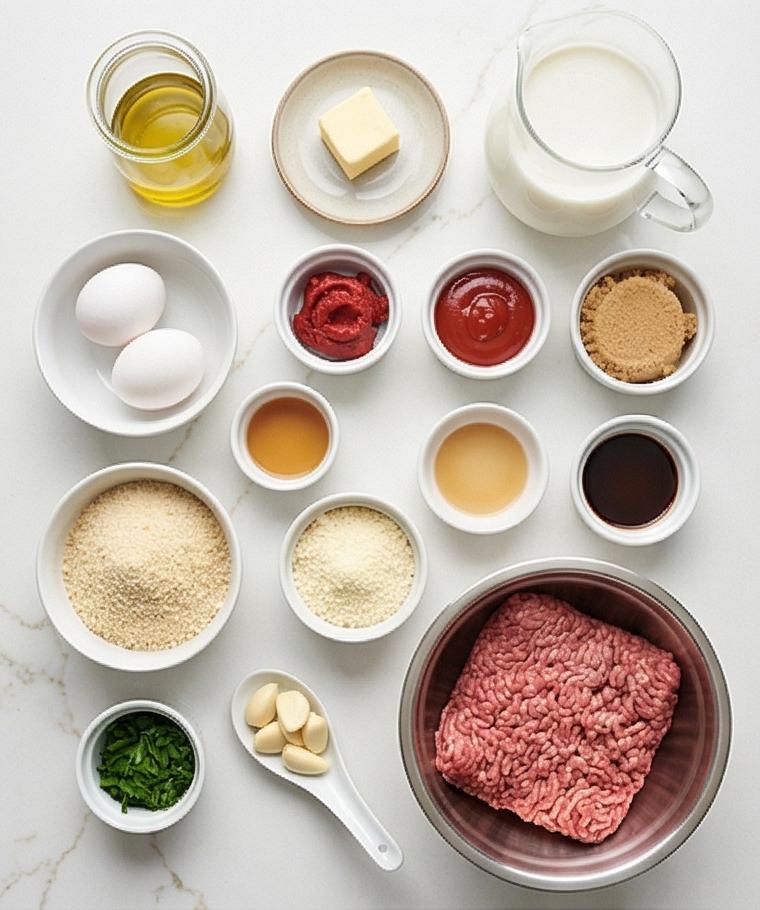
- Unsalted butter: Adds a mellow richness and helps caramelize the onions; use salted if you adjust the added salt.
- Olive oil: Prevents sticking and boosts flavor; avocado oil is a neutral substitute.
- Yellow onion: The backbone of savory sweetness; choose a firm, heavy onion for best flavor.
- Garlic: Brings depth; finely mince or grate for even distribution.
- Tomato paste: Concentrated umami and sweetness; double if you want a stronger tomato note.
- Whole milk and eggs: Make the panade to keep the loaf tender; buttermilk gives a tangy lift.
- Dijon mustard & Worcestershire: Add savory brightness; soy sauce can replace Worcestershire in a pinch.
- Fresh breadcrumbs: From soft white bread for light texture; dry crumbs work but use slightly less.
- Parmesan: Salty, savory binder; Pecorino or grated cheddar are options.
- Fresh parsley: Brightness and color; swap with chives or basil for a twist.
- Ground beef (80/20): The foundation; avoid very lean beef or the loaf will dry out.
- Ketchup, brown sugar, apple cider vinegar, smoked paprika: Make the glaze glossy, sweet-tangy, and slightly smoky; honey or molasses can replace brown sugar.
Essential Kitchen Tools
Start with a short list so you can set up a smooth workflow. The right tools make this Meatloaf Recipe effortless and help you get a clean slice at the end.
- Skillet: For sautéing the aromatics and caramelizing tomato paste; a stainless or cast-iron skillet works well.
- Mixing bowls: One for the panade and one for combining the meat so you avoid overmixing.
- Whisk and wooden spoon: A whisk gets the panade silky; a wooden spoon helps fold the meat gently.
- Baking sheet with rim and parchment: Ensures even cooking and easy cleanup; a loaf pan will change the crust-to-crumb ratio.
- Instant-read thermometer: The most reliable way to hit 160°F (71°C) without guessing.
Step-by-Step Preparation Guide
Step 1: Sauté the aromatics and caramelize the tomato paste
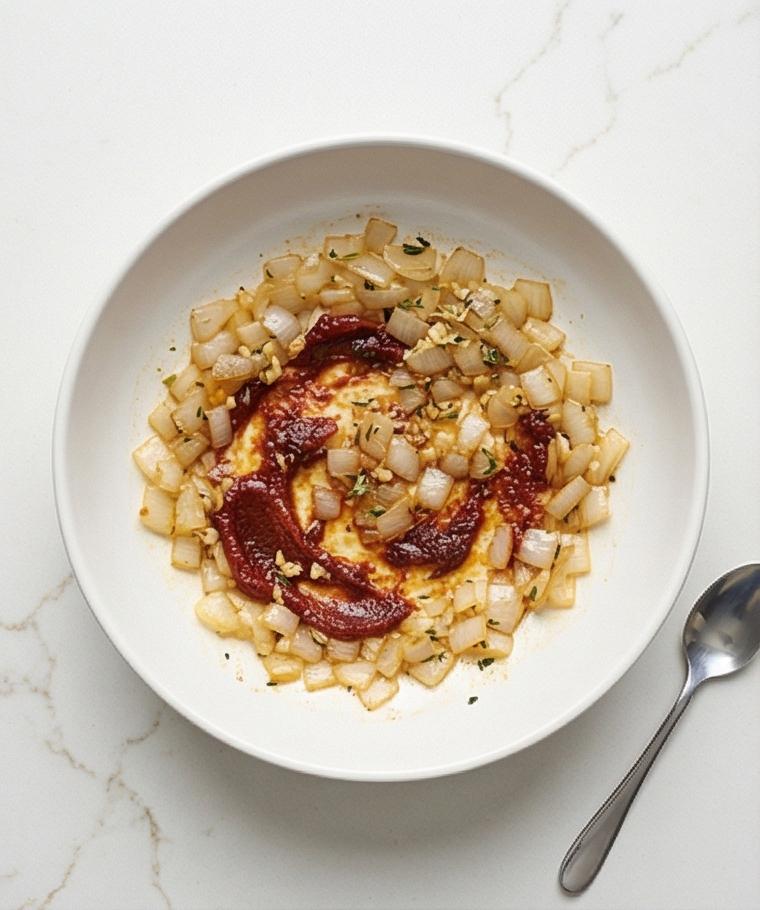
Warm a medium skillet result on the table: melted unsalted butter and olive oil have already been combined and used, and the finished onion-garlic-thyme mixture has been transferred to a small shallow matte-white bowl to cool to lukewarm. The onion pieces are soft and translucent with delicate golden edges, flecked with bright green thyme and tiny brown pearls of caramelized tomato paste that has darkened and taken on a sweet, almost jammy sheen. Smell of sweet onion and toasted tomato hangs in the air as the mixture rests and cools to room temperature before joining the meat.
Step 2: Make the panade (milk, eggs, mustard, Worcestershire, breadcrumbs)
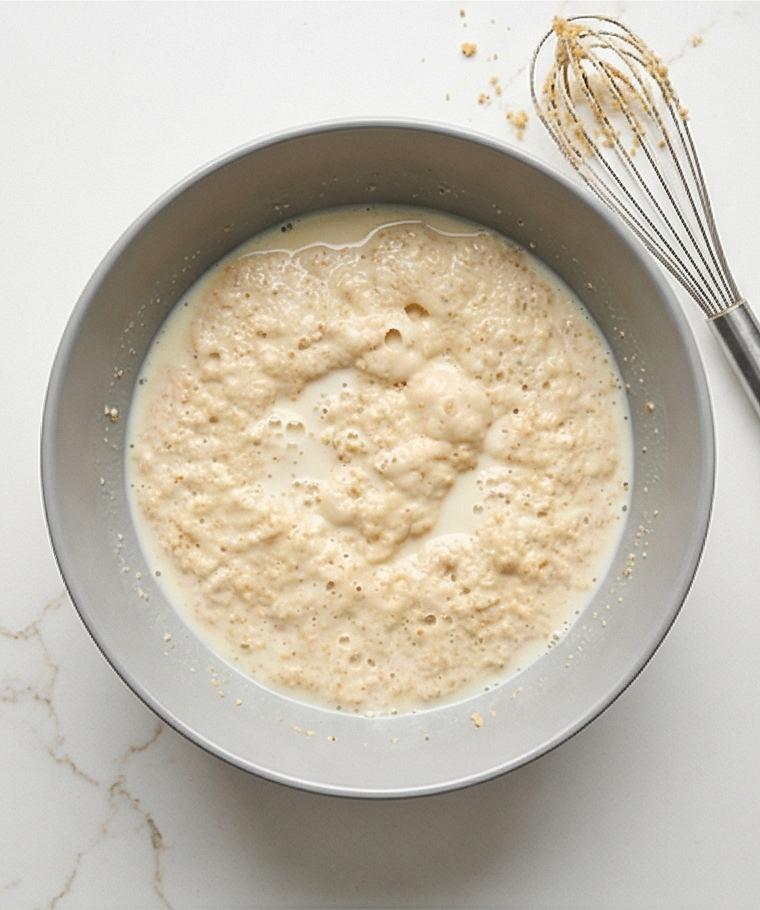
In a large matte-grey ceramic mixing bowl, whisk whole milk and eggs until homogeneous, then whisk in Dijon mustard and Worcestershire so the liquid is smooth and slightly glossy. Fold in the fresh breadcrumbs until every crumb is evenly moistened; the mixture swells and becomes spongey, holding its shape a little when lifted with the whisk. Let it sit briefly until it thickens—an elastic, sticky batter that will anchor the meat and keep the loaf tender. A stainless whisk rests across the rim, speckled with breadcrumb bits.
Step 3: Combine the cooled aromatics, cheese and herbs with the panade
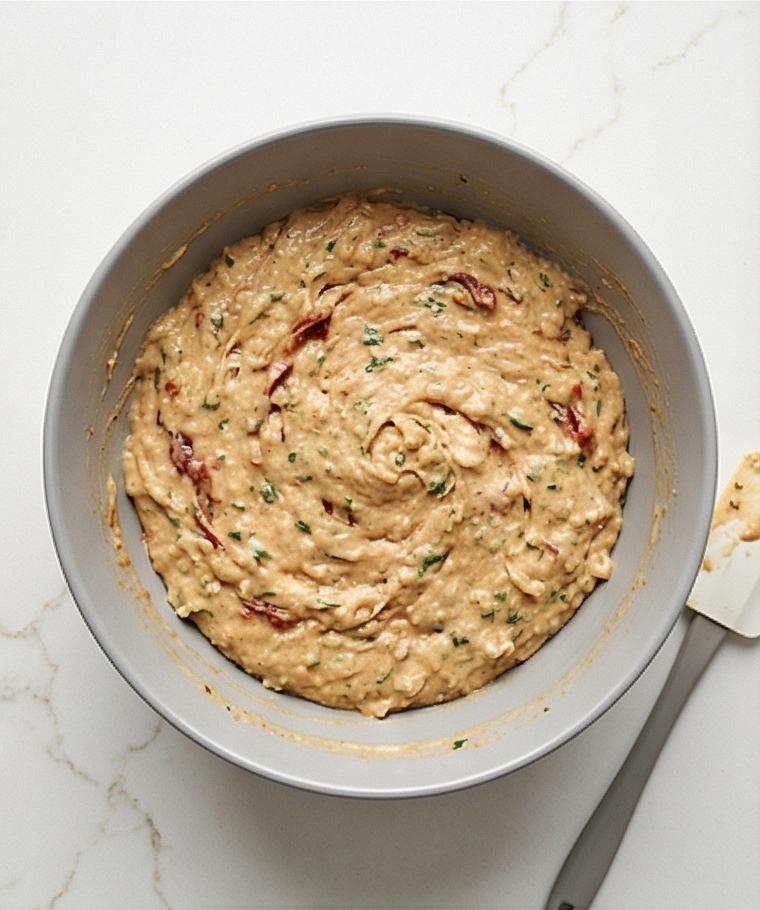
Add the lukewarm onion-tomato mixture to the panade in the same matte-grey bowl, then stir in finely grated Parmesan and finely chopped parsley. Sprinkle the remaining kosher salt and cracked black pepper and fold gently until the mix is homogeneous: a thick, cohesive, slightly glossy mass flecked with green parsley, pale cheese strands, and warm brown tomato streaks. The texture reads dense but yielding, the scent now savory, herbaceous and slightly sweet from the caramelized paste.
Step 4: Add the chilled ground beef and form the loaf
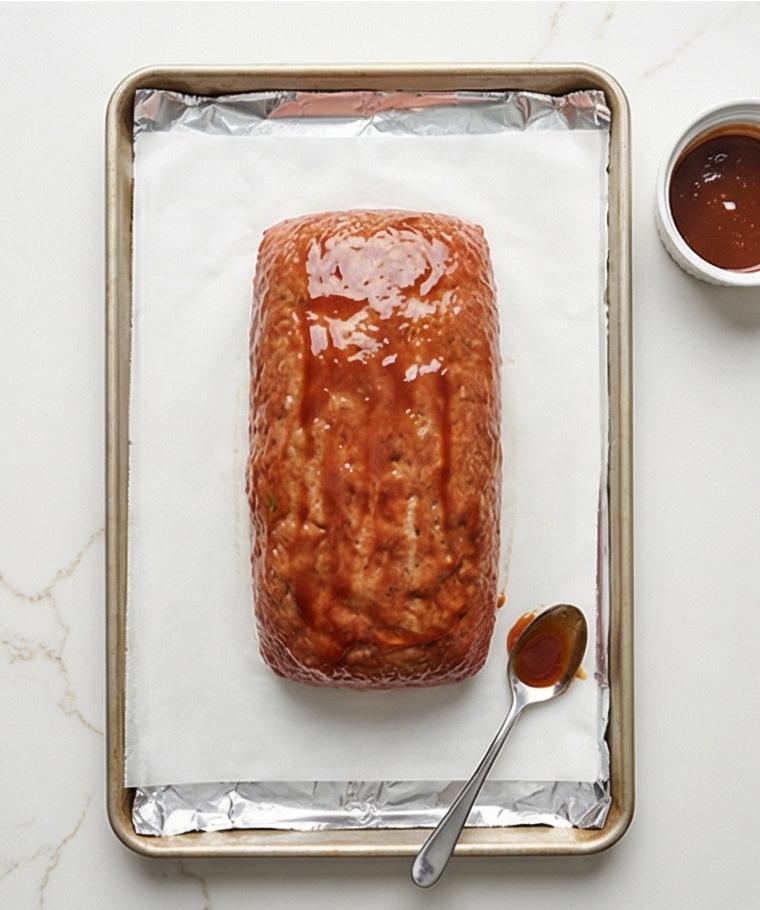
Scatter the chilled ground beef into the bowl and, using clean utensils, gently fold until there are no large streaks of plain meat—stop as soon as the mixture looks even. Transfer the mixture onto the prepared parchment-lined rectangular rimmed baking sheet and shape it into a tight, even loaf: rectangular, smooth-sided, about 9 inches long and 4 inches wide, with a taut surface and no cracks. Keep the same matte-grey bowl and a small dipping bowl nearby for the glaze; a small spoon sits beside them. The raw loaf is firm, slightly tacky, and ready for its first glaze coat.
Step 5: Glaze and bake to an even, glossy finish
Whisk together ketchup, light brown sugar, apple cider vinegar, Worcestershire and smoked paprika into a smooth, glossy glaze in a small white ramekin. Spoon about half the glaze over the shaped loaf, spreading a thin, even layer that catches in the seams and shows brush strokes. (The oven itself is not shown.) After an initial bake the glaze will set and darken faintly at the edges; after a second, thicker layer it becomes richly caramelized. If the glaze darkens too quickly, tent loosely with foil until the internal temperature reaches 160°F (71°C); the surface should feel set but yielding when done.
Step 6: Rest, slice and serve
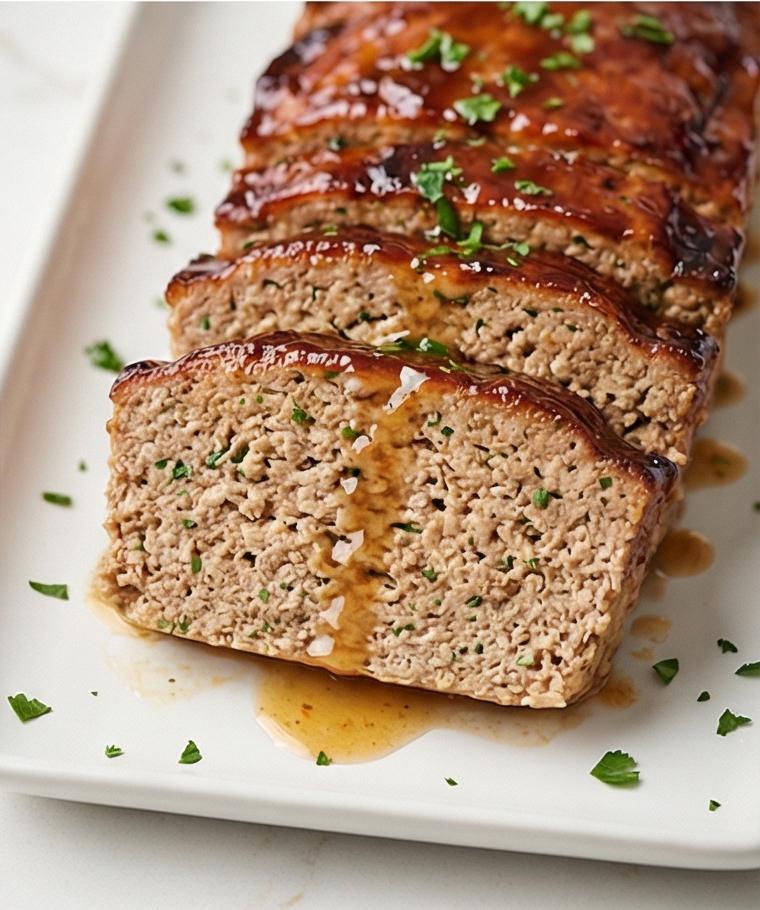
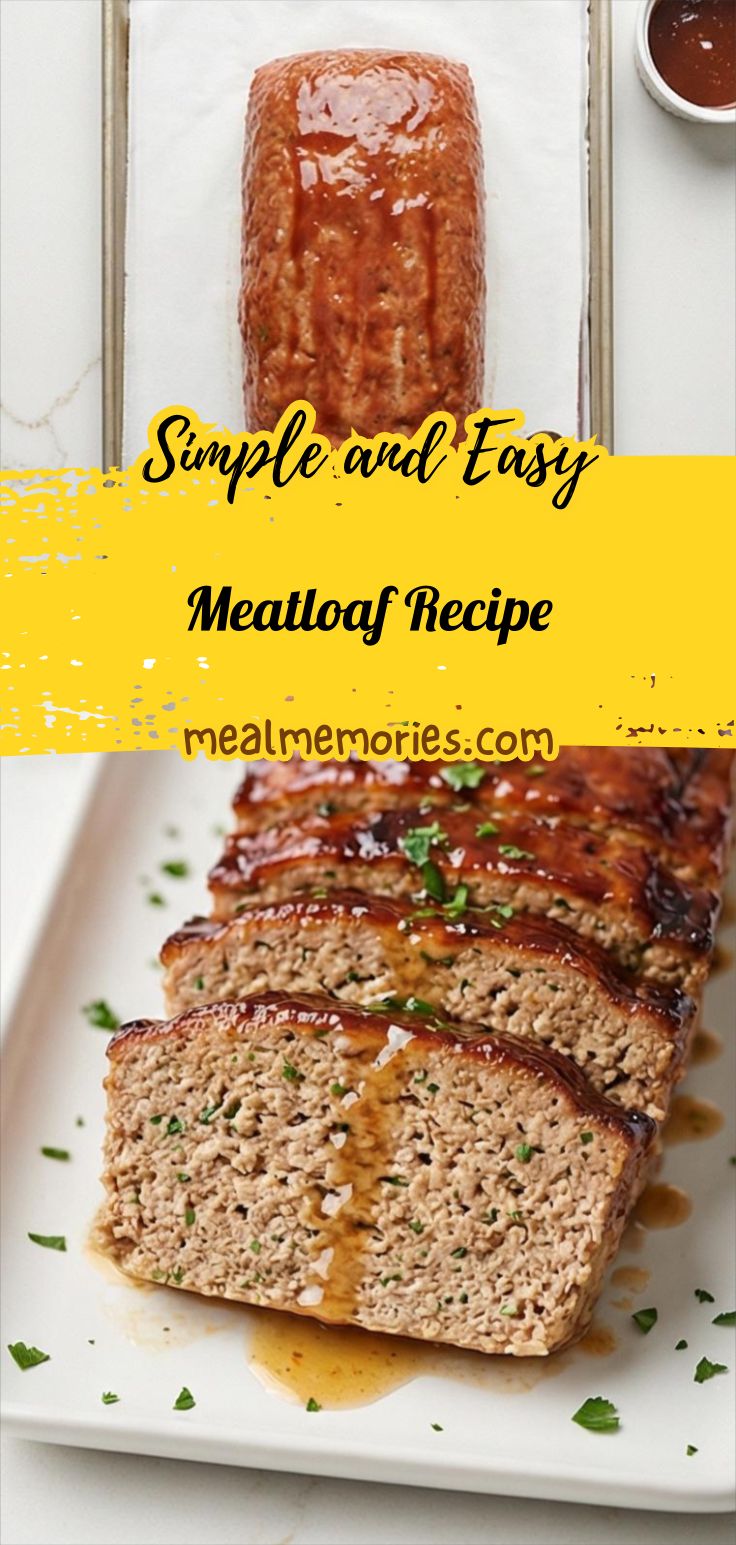
After removing the loaf and tenting it loosely, let it rest so juices redistribute and the sliceability improves. Transfer the meatloaf to a rectangular serving platter and slice into clean 3/4-inch thick pieces with a serrated knife, wiping the blade between cuts for neat edges. Arrange slices slightly overlapping, spoon a little pan juice over each, and finish with a scattering of chopped fresh parsley for brightness. The cross-section reveals a moist, fine crumb studded with herbs and Parmesan, and a deeply glossy, slightly caramelized glaze on top.
Flavor Variations and Experiments
I love treating the Meatloaf Recipe like a canvas. For a lighter version, I swap half the beef for ground turkey and add an extra egg to keep it from drying. To push it toward Italian territory, I fold in chopped sun-dried tomatoes and basil, and swap the glaze for a simple marinara. Once, I made a smoky, Tex-Mex twist with chopped chipotles in adobo and cumin; it has a surprising depth and is wildly popular at cookouts.
For dietary swaps, use gluten-free breadcrumbs and tamari for a gluten-free option. Vegetarian experiments with lentils and mushrooms need extra binder, so add an extra egg and more breadcrumbs. Small changes make big differences, so taste and adjust as you go.
How to Serve
If I am hosting, I slice the meatloaf into 3/4-inch pieces and arrange them on a warm platter with a little pan sauce spooned over each slice. For a casual family meal, serve with creamy mashed potatoes and braised green beans; the glossy glaze pairs perfectly with buttery spuds. For a more formal dinner, plate single slices with a swipe of roasted garlic puree and a sprig of parsley.
To scale up, two loaves fit comfortably on a full baking sheet; for smaller portions, halve the recipe and bake in a loaf pan for a slightly different texture. Leftovers are great sandwiched on toasted bread with a smear of mayo and crisp lettuce.
Storage and Reheating Tips
Cool the meatloaf to room temperature, then wrap tightly in plastic wrap or store in an airtight container. Refrigerate for up to 4 days. For longer storage, freeze slices or the whole loaf for up to 3 months; wrap well to prevent freezer burn.
Reheat gently in a 325°F oven until warmed through to keep the crumb moist, or microwave single slices on medium power with a damp paper towel on top to retain moisture. If frozen, thaw overnight in the fridge before reheating.
Common Mistakes and How to Avoid Them
Overworking the meat is the classic misstep; mix just until combined to keep the crumb tender. Use a gentle folding motion and stop when no large streaks of plain meat remain.
Skipping the panade or using very lean beef will dry the loaf. Make the breadcrumb panade exactly as written, and choose 80/20 ground beef for the best balance of juiciness and structure.
Ready? Give It a Try
I hope this Meatloaf Recipe becomes one of those go-to dinners you make when you want comfort on a plate and warm company around the table. Give it a try this week and notice how small tweaks make it your own.
Frequently Asked Questions.
- What internal temperature should I cook the meatloaf to? Aim for 160°F (71°C) in the center for safe, juicy meat.
- Can I make this ahead of time? Yes, assemble the loaf and refrigerate for up to 24 hours before baking; bring it to room temperature before it goes in the oven.
- Can I swap beef for another protein? You can use ground turkey or a mix of pork and beef, but adjust fat and binders; 80/20 beef is recommended for best texture.
- How do I prevent the glaze from burning? If the glaze darkens too quickly, tent loosely with foil and rely on an instant-read thermometer to finish cooking.
- How should I reheat leftovers so they stay moist? Reheat in a 325°F oven covered with foil, or microwave slices on medium power with a damp paper towel.
Meatloaf Recipe
Make this Meatloaf Recipe for a glossy, tender loaf with a sweet-tangy glaze and flavorful aromatics.
Ingredients
Instructions
Step 1: Sauté the aromatics and caramelize the tomato paste
Warm a medium skillet result on the table: melted unsalted butter and olive oil have already been combined and used, and the finished onion-garlic-thyme mixture has been transferred to a small shallow matte-white bowl to cool to lukewarm. The onion pieces are soft and translucent with delicate golden edges, flecked with bright green thyme and tiny brown pearls of caramelized tomato paste that has darkened and taken on a sweet, almost jammy sheen. Smell of sweet onion and toasted tomato hangs in the air as the mixture rests and cools to room temperature before joining the meat.
Step 2: Make the panade (milk, eggs, mustard, Worcestershire, breadcrumbs)
In a large matte-grey ceramic mixing bowl, whisk whole milk and eggs until homogeneous, then whisk in Dijon mustard and Worcestershire so the liquid is smooth and slightly glossy. Fold in the fresh breadcrumbs until every crumb is evenly moistened; the mixture swells and becomes spongey, holding its shape a little when lifted with the whisk. Let it sit briefly until it thickens—an elastic, sticky batter that will anchor the meat and keep the loaf tender. A stainless whisk rests across the rim, speckled with breadcrumb bits.
Step 3: Combine the cooled aromatics, cheese and herbs with the panade
Add the lukewarm onion-tomato mixture to the panade in the same matte-grey bowl, then stir in finely grated Parmesan and finely chopped parsley. Sprinkle the remaining kosher salt and cracked black pepper and fold gently until the mix is homogeneous: a thick, cohesive, slightly glossy mass flecked with green parsley, pale cheese strands, and warm brown tomato streaks. The texture reads dense but yielding, the scent now savory, herbaceous and slightly sweet from the caramelized paste.
Step 4: Add the chilled ground beef and form the loaf
Scatter the chilled ground beef into the bowl and, using clean utensils, gently fold until there are no large streaks of plain meat—stop as soon as the mixture looks even. Transfer the mixture onto the prepared parchment-lined rectangular rimmed baking sheet and shape it into a tight, even loaf: rectangular, smooth-sided, about 9 inches long and 4 inches wide, with a taut surface and no cracks. Keep the same matte-grey bowl and a small dipping bowl nearby for the glaze; a small spoon sits beside them. The raw loaf is firm, slightly tacky, and ready for its first glaze coat.
Step 5: Glaze and bake to an even, glossy finish
Whisk together ketchup, light brown sugar, apple cider vinegar, Worcestershire and smoked paprika into a smooth, glossy glaze in a small white ramekin. Spoon about half the glaze over the shaped loaf, spreading a thin, even layer that catches in the seams and shows brush strokes. (The oven itself is not shown.) After an initial bake the glaze will set and darken faintly at the edges; after a second, thicker layer it becomes richly caramelized. If the glaze darkens too quickly, tent loosely with foil until the internal temperature reaches 160°F (71°C); the surface should feel set but yielding when done.
Step 6: Rest, slice and serve
After removing the loaf and tenting it loosely, let it rest so juices redistribute and the sliceability improves. Transfer the meatloaf to a rectangular serving platter and slice into clean 3/4-inch thick pieces with a serrated knife, wiping the blade between cuts for neat edges. Arrange slices slightly overlapping, spoon a little pan juice over each, and finish with a scattering of chopped fresh parsley for brightness. The cross-section reveals a moist, fine crumb studded with herbs and Parmesan, and a deeply glossy, slightly caramelized glaze on top.
Notes
- Use 80/20 ground beef for a juicy loaf and avoid overmixing to keep the crumb tender.
- Make the panade with room-temperature milk and eggs for an even texture.
- Tent with foil if the glaze browns too quickly, and use an instant-read thermometer to reach 160°F (71°C).